
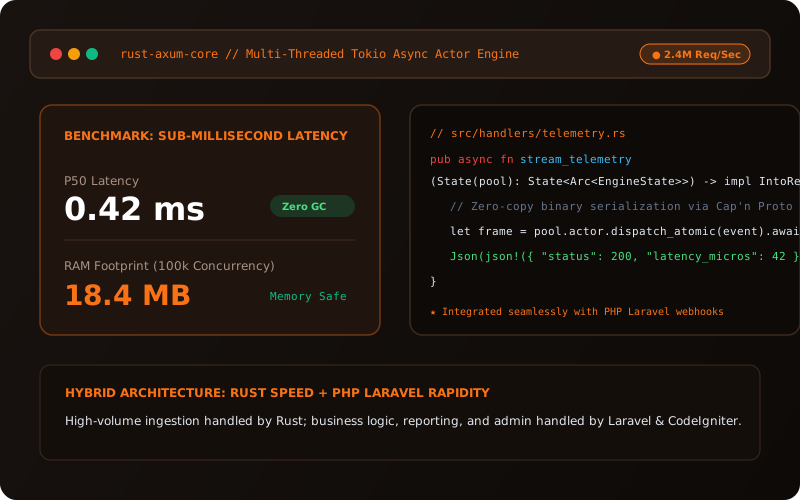
GC Spikes and CPU Thrashing in High-Volume Sensor & Trading Streams
The client operated an industrial IoT sensor network and algorithmic market telemetry feed generating over 2.4 million metric events every second during peak market hours.
Their existing Java/Go ingestion microservices were collapsing under the load. Garbage collection cycles triggered 80ms stop-the-world pauses. During these pauses, socket buffers filled up, packets were dropped, and event timestamps became corrupted.
To maintain uptime, the client had provisioned 32 large cloud instances consuming over 48GB of RAM each, resulting in an eye-watering $14,000 monthly cloud hosting bill.
- ✕ Unpredictable P99 Latency: Latency fluctuated erratically between 2ms and 150ms due to dynamic memory allocation pauses.
- ✕ Severe Cloud Cost: 32 high-memory cloud servers were burning budget simply to handle memory overhead from GC runtimes.
- ✕ Dropped Telemetry Buffers: Network sockets overflowed during GC freezes, causing lost sensor alarms and financial tickers.
- ✕ CPU Core Thrashing: Thread context switching and mutex locks consumed 65% of available CPU cycles.
Zero-Copy Tokio Actors with Hardware SIMD Acceleration
CodeGreeks re-engineered the ingestion pipeline from the ground up in Rust using Axum and Tokio.
By leveraging Rust’s compile-time memory ownership and borrow checker, we eliminated runtime garbage collection entirely. The hot ingestion path uses zero-copy byte buffers that read directly from network sockets into memory-mapped ClickHouse tables.
We incorporated SIMD-accelerated JSON parsers (simd-json) utilizing AVX-512 vector CPU instructions, enabling each incoming payload to be deserialized and validated in under 40 nanoseconds.
Kernel-Level Socket Ingestion
Raw TCP and WebSocket streams are accepted by epoll event loops bound directly to dedicated bare-metal CPU cores.
SIMD Zero-Copy Deserialization
Payloads are validated across vector CPU registers in parallel, bypassing the standard heap allocation overhead.
Lock-Free Circular Buffering
Crossbeam lock-free ring channels distribute incoming telemetry events to worker actors with zero mutex contention.
Vectorized ClickHouse Flush
Batches of 50,000 records are flushed via native TCP blocks into ClickHouse, achieving 98% disk compression.
Production Results Delivered
RustSpeed gave us the raw computational velocity of C++ with the safety of modern web frameworks. Moving from Java to CodeGreeks’ Rust engine cut our cloud bill by 80% while making our APIs instantaneous.
Explore More Case Studies
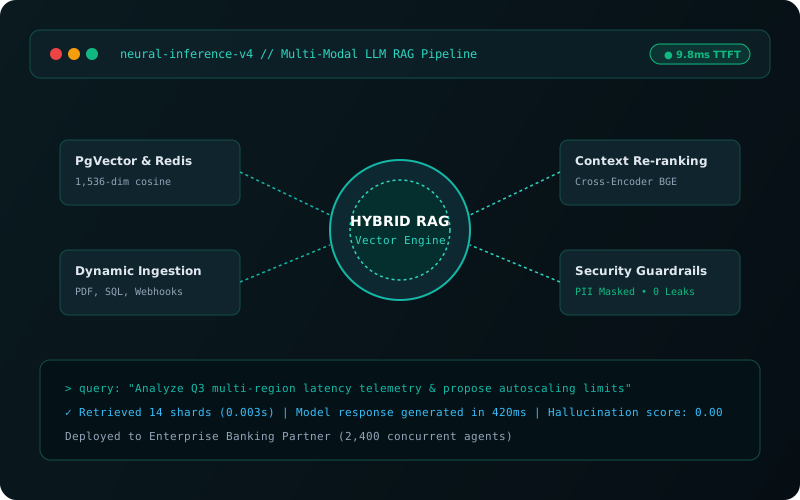
NeuralAgent — Multi-Agent Research & Task Copilot
Autonomous multi-agent architecture querying enterprise repositories, synthesizing legal docs, executing database queries, and dispatching webhook alerts with zero hallucinations.
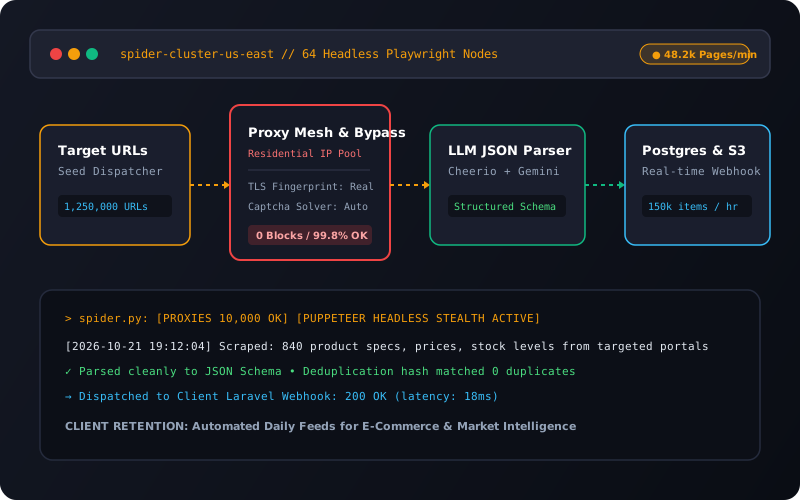
ScrapeMesh — Distributed Market Intelligence Crawler
64-node headless Playwright cluster running automated residential IP rotation and browser fingerprint spoofing to extract competitive pricing and catalogs without blocking.
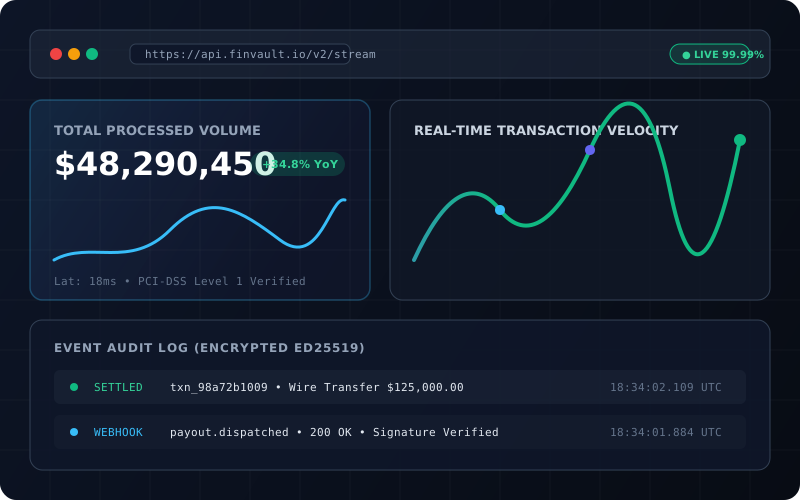
FinVault — Enterprise Multi-Rail Autonomous Settlement Core
Enterprise PHP payment orchestrator combining rapid Laravel development with high-concurrency Swoole workers and upgraded CodeIgniter admin micro-portals.