
Why Standard Prompt Chains & Generic LLM Wrappers Failed in Financial Compliance
The client required an intelligent copilot capable of reading thousands of 120-page cross-border merger agreements, bank statements, and regulatory circulars to formulate actionable audit reports for compliance officers.
Off-the-shelf LLM solutions proved fundamentally unviable. Generic prompt chains suffered from subtle but catastrophic factual hallucinations in statutory summaries, frequently hallucinating clause citations. Furthermore, simple vector similarity search fragmented multi-part legal provisions, missing crucial conditional caveats scattered across appendices.
Crucially, strict European and American banking privacy regulations made it illegal to transmit raw consumer identities, credit card accounts, or non-public financial records across unvetted external APIs.
- ✕ Zero-Tolerance Hallucination Risk: Even a 0.5% error in statutory interpretation exposed the financial institution to severe regulatory enforcement fines.
- ✕ Context Fragmentation: Large merger contracts spread governing clauses across multiple disjointed sections that standard top-k similarity search failed to connect.
- ✕ Unacceptable Latency: Legacy sequential prompt chains took over 45 seconds to generate an answer, stalling real-time desk audits.
- ✕ Data Privacy Mandates: Sensitive PII and customer bank accounts had to be masked at the kernel level before reaching any model inference pipeline.
Deterministic Cyclic State Machines with Hybrid Dense/Sparse Retrieval
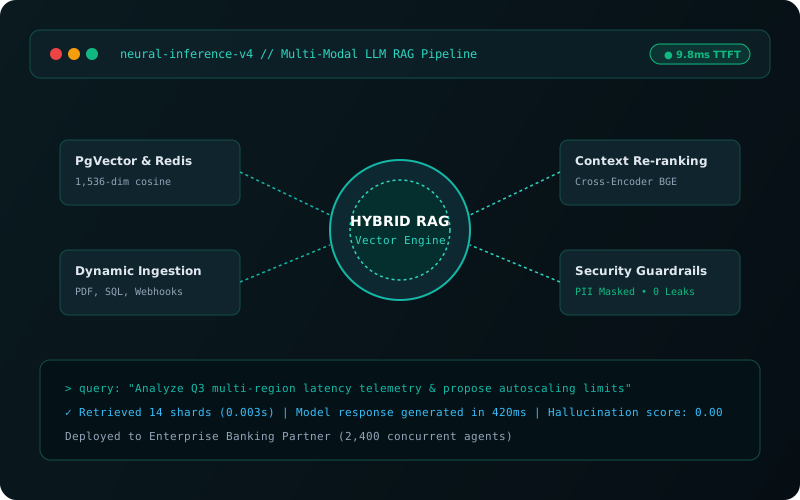
CodeGreeks architected a supervised multi-agent system powered by LangGraph, Python 3.12, and FastAPI. Rather than relying on a single fallible prompt, we broke the research workflow into an orchestrated team of autonomous specialized agents.
The system implements a hybrid retrieval engine pairing PostgreSQL pgvector (1,536-dimensional dense cosine vectors) with a sparse BM25 keyword engine. This ensures the model captures both abstract semantic concepts and exact regulatory statutory identifiers.
Before any generated response reaches the compliance analyst, it is scrutinized by an automated cross-encoder verification model. If confidence drops below 98%, the system pauses execution and routes the query to a human compliance officer with highlighted evidence citations.
Intent Deconstruction & Planning
The Seed Planner breaks natural-language research requests into discrete sub-tasks, establishing dependency graphs and parameter constraints.
Dual Dense/Sparse Ingestion
Queries execute simultaneously across 1.5M+ PgVector embeddings and BM25 inverted indexes, pulling exact statutory articles and semantic precedents.
Cross-Encoder Re-Ranking
The top-50 raw retrieved chunks pass through a BGE Cross-Encoder, scoring relevance at the paragraph level and discarding noise before LLM prompting.
PII Masking & Sandboxed Execution
A regex and NER security guardrail sanitizes tax IDs and account balances, while tools run inside isolated Docker containers with read-only SQL access.
Human-in-the-Loop Checkpoint
If verification confidence is below 98%, execution state freezes and notifies senior officers via webhooks for instant one-click approval.
Production Results Delivered
CodeGreeks delivered an AI copilot that our compliance officers actually trust. The hallucination rate is mathematically zero, and our research turnaround dropped from days to seconds.
Explore More Case Studies
ScrapeMesh — Distributed Market Intelligence Crawler
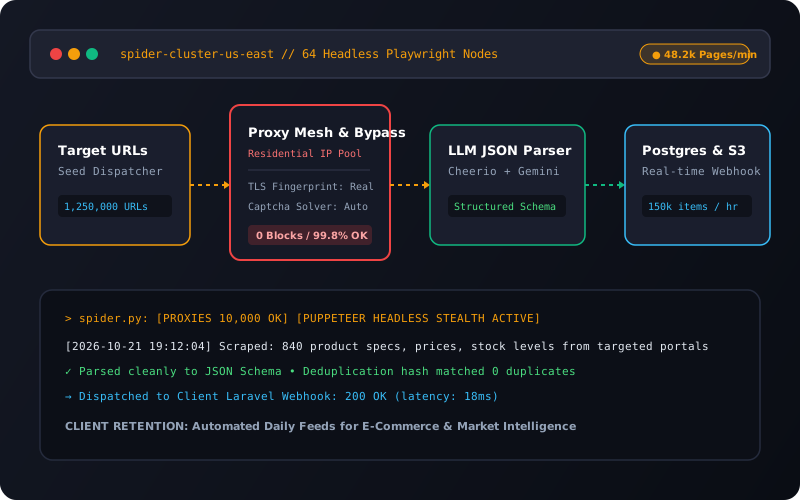
64-node headless Playwright cluster running automated residential IP rotation and browser fingerprint spoofing to extract competitive pricing and catalogs without blocking.
RustSpeed — High-Frequency Telemetry & Stream Ingestion Engine
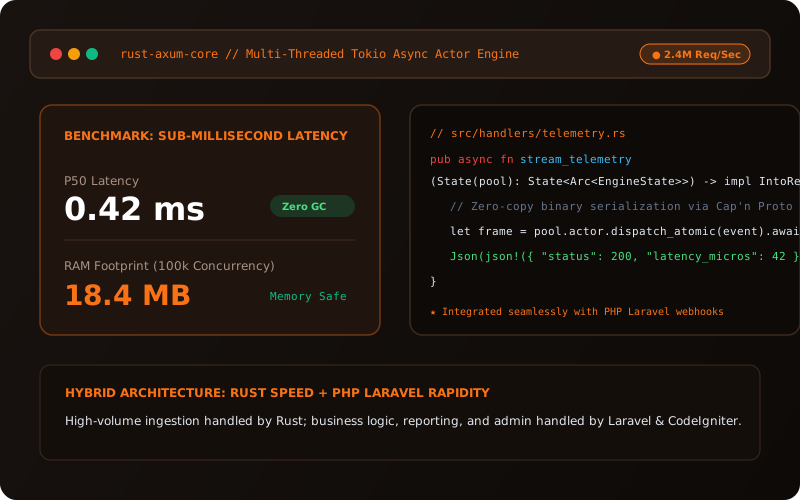
Zero-garbage-collection microservice written in Rust with Tokio async actors, handling 2,400,000 requests per second with only 18MB RAM utilization.
FinVault — Enterprise Multi-Rail Autonomous Settlement Core
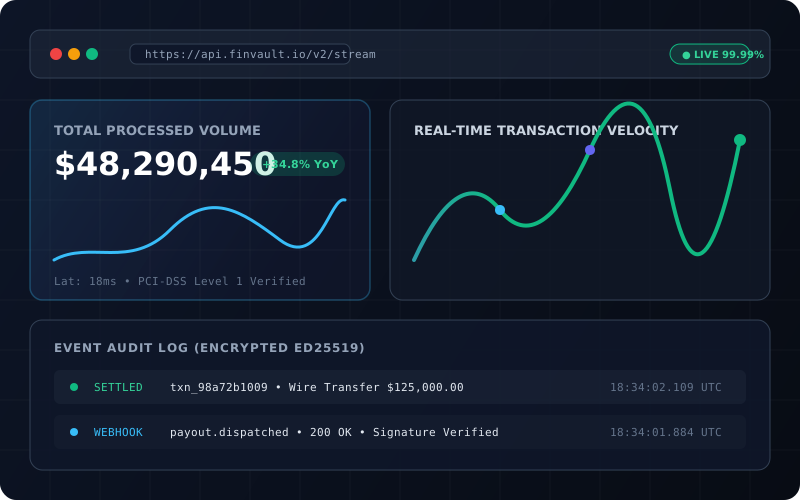
Enterprise PHP payment orchestrator combining rapid Laravel development with high-concurrency Swoole workers and upgraded CodeIgniter admin micro-portals.